
KLOW Get
Does more KLOW peptide mean better results?
Four peptides, several repair pathways, a bigger effect. The idea sounds tidy. An awkward result has me questioning the arithmetic.
The highest amount gave no significant benefit
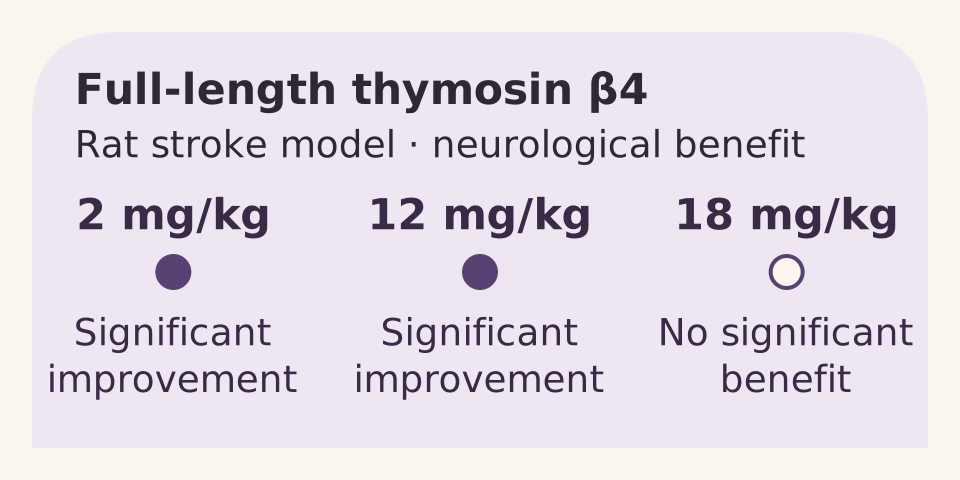
In a rat stroke experiment, full-length thymosin beta-4 improved neurological function at 2 and 12 mg/kg. At 18 mg/kg, the researchers found no significant benefit. This was an animal experiment with a particular injury and a particular protein. It supplies no human dose for KLOW peptide, which contains the shorter TB-500 fragment.
Still, the result bothers a very familiar assumption: that getting more of a promising substance brings more of the desired effect. The largest amount seemed the obvious candidate for the strongest result, until the study contradicted that expectation. The paper refuses that neat ending.
“Get” can mean obtaining something. The more interesting question here is what anyone gets out of it. With KLOW, the appeal of more runs through the ingredient list, the repair claims and the quantities printed on a label. I think that appeal deserves an experiment at every step.
A disappointing comparison earns its space. Removing it would make the story easier to tell and much harder to trust.
What is KLOW peptide?
KLOW peptide combines KPV, GHK-Cu, BPC-157 and TB-500. These remain separate molecules in a fixed-ratio preparation. “Peptide” means a short chain of amino acids; the name gathers several different chains under one convenient heading.
The research rationale draws on separate repair mechanisms: KPV for inflammatory signaling, GHK-Cu for collagen and the surrounding tissue matrix, BPC-157 for tendon repair and blood-vessel signaling, and TB-500 for a cell-migration story largely established with its parent protein. None of the ingredients is an established weight-loss agent or a GLP-1 drug.
That is a substantial list of ambitions. The missing measurement is the added benefit of combining them. No controlled study has compared the four-peptide blend with its ingredients, a smaller combination or placebo.
Adding KPV
KLOW differs from GLOW by including KPV. There is a concrete reason to be interested in that addition: KPV reduced inflammatory signaling in cultured intestinal and immune cells and reduced colitis severity in mice. Those findings give the extra ingredient a plausible job.
They leave the size of its contribution to KLOW unmeasured. Community descriptions of a broader “less inflamed” feeling are anecdotal accounts, without clinical evidence for the blend. Covering several repair processes at once appeals to me. Calling the larger ingredient count a benefit requires a result the addition actually improves.
Following a reported improvement
The commonly listed 80 mg composition contains GHK-Cu 50 mg, BPC-157 10 mg, TB-500 10 mg and KPV 10 mg. GHK-Cu therefore occupies most of the preparation by mass. That composition has never been established as a human treatment dose. The quantities page follows the label and the clearance research.
For a claim about feeling better, the useful starting point is the benefits and side effects: the knee-pain case series, the community accounts, and the reports of no noticeable effect. The research page goes into the experiments themselves. An advantage measured for the whole preparation would persuade me, with its unwanted effects counted alongside it. The larger ingredient list alone leaves me unconvinced.